
People with all types of scars often believe nothing can be done to remove them. Fortunately, many scars, including keloids, hypertrophic and atrophic scars, can all be treated effectively by a skilled and specialized plastic surgeon.
What are Atrophic Scars?
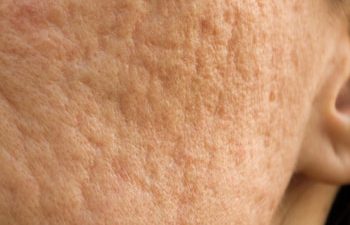
Atrophic scars develop when skin doesn’t regenerate properly after a wound or eruption, like acne or chicken pox scars. Another type of atrophic scar happens after a burn, especially a severe burn. Finally, atrophic scars can develop after Mohs treatment, a reconstructive surgery after cancerous tissue removal.
The most familiar atrophic scars are acne or chicken pox scars. In addition, burns can often develop into atrophic scars, as the skin tightens and contracts during healing to compensate for the burned skin.
There are three types of atrophic scars, each being quite different from the others. First, the pitted, indented scars, are known as icepick scars. Next are the boxcar scars, which are flat on the bottom. Finally, rolling scars do not have a clear edge or boundary and are often found on the cheeks.
Are Atrophic Scars Keloids?
Atrophic scars are different from keloids. Atrophic scars are due to the healing that happens underneath the skin and are indented. Keloids are thick, raised scars that move beyond the boundaries of the injury. Keloids are made of a collagen buildup and are firm and hard or fibrous and shiny.
How are Atrophic Scars Treated?
There are several different treatments for atrophic scars, including potential surgery. Because surgery is a possible outcome, it’s important to work with atrophic scar specialists to obtain the best possible results. It’s important to begin with a consultation, so the doctor can determine what type of atrophic scars you have and how best to treat them. The scarring can often be treated with less invasive treatments, including chemical peels, fat grafting, microneedling, dermabrasion, dermal fillers and laser resurfacing.
If you have atrophic scars you want removed, it’s vital to speak with a surgeon who specializes in scar removal. Even if other doctors have told you there is nothing they can do, you may be able to find expert treatment in Orlando, Florida. Contact us today to learn more or schedule a consultation.
Posted on behalf of
130 Hillcrest St
Orlando, FL 32801
Phone: (833) 653-8043
Mon - Fri: 8:30AM - 5:30PMSat - Sun: Closed


